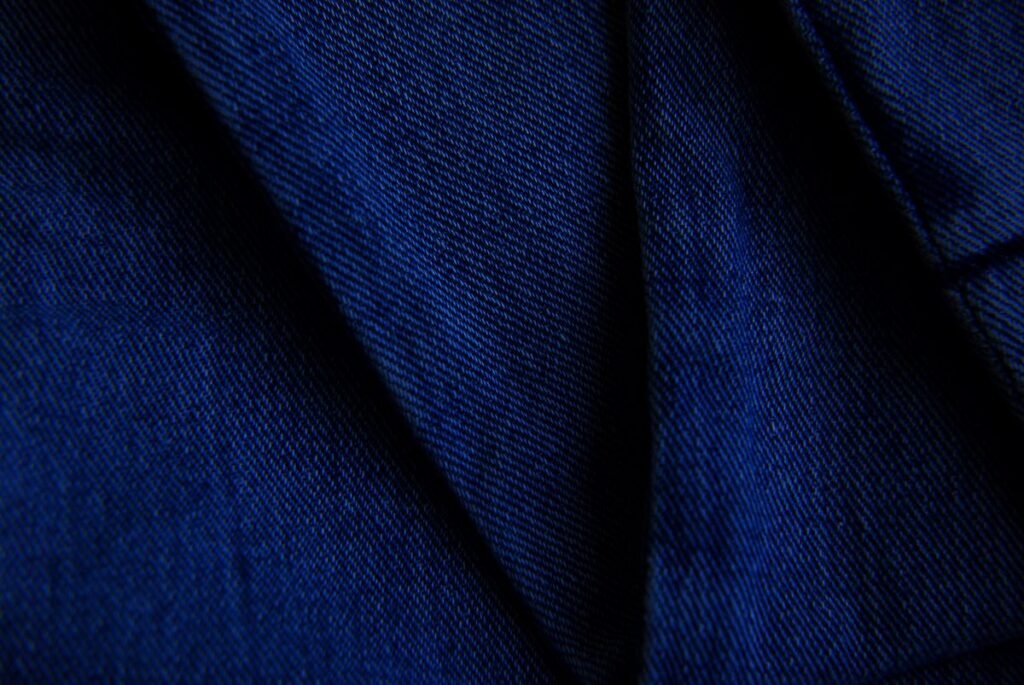
SR_A has unveiled GRIND Editorial, a collection that makes the indigo vat its central design tool rather than a finishing detail. Announced in November 2026, the line covers parkas, jackets, zip hoodies and tracksuits, each put through a 72-hour handmade indigo dyeing process after the garment is assembled. The result is a range where technical outerwear, natural silk and retro sportswear share the same deep-blue palette but rarely the same exact shade.
Why a 72-hour hand dye changes the garment
Dyeing a finished piece, rather than fabric rolls before cutting, changes what colour has to negotiate. Seams, trims, linings and different fibre surfaces take up pigment at different rates, so a single bath produces subtle variation instead of uniform flatness. SR_A describes manual dyeing, fading and distressing as the source of the collection’s texture. For readers used to indigo mainly as a denim wash, the point is that the process becomes a record of construction: the garment’s architecture remains visible in the colour.
That choice carries a production cost. A three-day dye cycle slows throughput and makes each unit harder to standardise, which is awkward for a business built on repeatable sizes and consistent e-commerce photography. It also puts pressure on dyehouse labour and water management, even when the visual outcome is deliberately irregular. The trade-off is a product story that cannot be reproduced by a digital print: scarcity is built into the method, not added as a marketing label.
Materials that cross continents
The outerwear reads like a materials itinerary. The BONDED GARNET INDIGO SILK PARKA pairs Italian Limonta water-repellent cloth with natural raw silk from Jaipur; the SILENT FOREST version uses matte gabardine. Vintage brass hardware and vegetable-tanned leather brim details carry Japanese Sashiko embroidery, while the BRONZE TINT jacket turns crinkled raw silk into a high-collar shape with satin lining. The CERU shell parka stays with lightweight cotton, adjustable webbing and vintage prints. None of these choices is cheap, but together they argue that functionality and handcraft can occupy the same pattern card.
Sportswear receives the same treatment with a lighter hand. AQUA, MARINE and WOODLAND zip hoodies and the VIOLET raglan keep cropped proportions and dropped shoulders associated with vintage athletic wear. MARINE switches to waffle cotton and a closer athletic cut; the others use high-temperature plastisol printing, bleaching, sun-fading and local distressing to simulate years of wear. TREATED INDIGO quarter-zip pullovers and joggers use brushed, high-density cotton with water-based distressed prints and zip pockets, bringing utility details to the retro silhouette.
What connects these very different inputs is the decision to let them age together in one dye cycle. An Italian technical shell and a Jaipur silk lining do not behave identically in an indigo bath, and the collection treats that unevenness as surface interest. It is a more convincing form of material storytelling than simply listing origins on a hangtag, because the visible finish is a consequence of the claimed process.
What to watch before GRIND reaches the shops
SR_A says the collection has debuted, but release dates, pricing and distribution have not been announced. Those details matter more than usual here. If the line arrives at a small scale with a clear explanation of the dyeing process, the irregular finish will read as intentional craft; if it is expanded quickly, buyers will look for evidence that the 72-hour claim still applies to every piece. Care instructions will be another test, since hand-dyed indigo can continue to shift with washing and light exposure.
For the wider industry, GRIND is part of a longer move toward process-led design: heritage techniques are being used to differentiate products in a market where technical specifications are easy to copy. The next question is not whether indigo is fashionable again, but whether brands can describe exactly who dyed the garment, for how long, and with what environmental controls. Collections like this make that question harder to dodge, and they give consumers a visible reason to ask it.